September 2026
One possibility I find genuinely hopeful about AI is that we may get much better at applying game design to reality.
Good games are very carefully designed around human motivation. They give you problems that are hard enough to feel satisfying, but not so hard that you give up. They give you autonomy, visible progress, increasing mastery, social roles, status, and the feeling that what you do matters.
Real life was never designed this way.
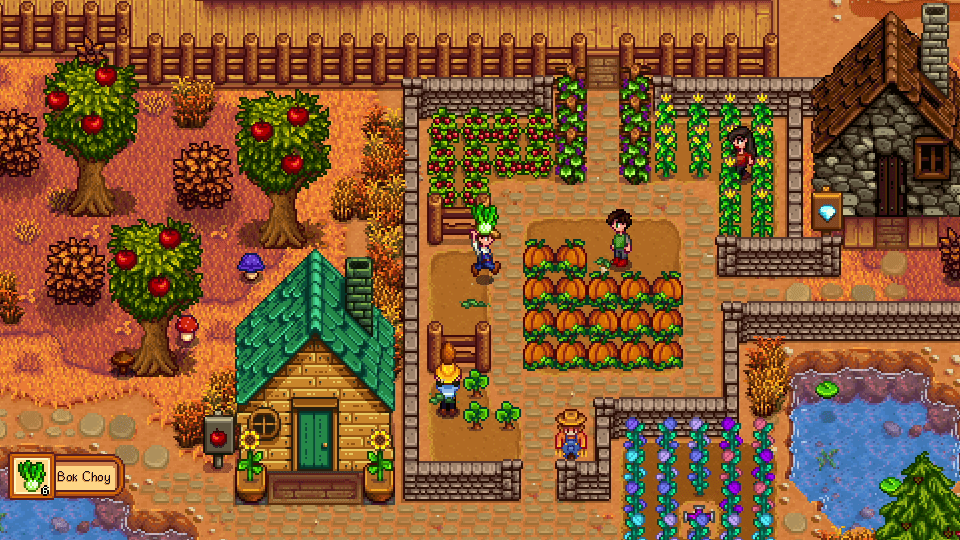
Take the romantic idea of a homestead or small village. Grow food, know your neighbours, cook together, trade locally, build things, have festivals, be useful to the people around you.
A lot of people want some version of this.
But historically it comes bundled with a huge amount of bad difficulty: crops failing because of weather, repetitive physical labour, broken equipment, financial stress, paperwork, shortages, isolation, and endless maintenance.
A game designer would look at that and say the difficulty curve is terrible.
The interesting thing about AI and automation is that they may let us unbundle difficulty.
Keep the farmer deciding what to grow, learning the land, caring for animals, bringing food to market and becoming someone the community knows. Let AI worry about irrigation schedules, disease detection, inventory, weather optimization and paperwork.
Keep the communal dinner, but automate the six hours of prep and cleanup nobody wants to do.
Keep the craftsperson making something for a neighbour, but give them tools that remove the dangerous, repetitive and frustrating parts.
The point isn’t to make everything effortless. A game with no difficulty isn’t satisfying either.
The goal would be to preserve good difficulty: learning something, getting better, taking responsibility, solving problems, helping other people, earning trust and status.
And reduce bad difficulty: drudgery, pointless administration, unnecessary risk, catastrophic failure and work that nobody particularly wants to do.
For most of history we didn’t have much control over that mix. Meaningful parts of work and miserable parts of work arrived bundled together.
AI might give us enough control over the underlying machinery that we can start designing the experience itself.
That suggests a different way of thinking about a future where human labour is less necessary.
Instead of asking only what jobs will be left for humans, we could ask what roles are worth creating for humans.
Not fake tasks or busywork. Real things that other people value, but designed with the same care that good games use to create challenge, mastery, cooperation, progression and meaning.
Video games already show that humans will happily spend thousands of hours doing difficult things when the difficulty is well designed.
Maybe one of the more interesting uses of AI is taking what we’ve learned from designing those worlds and finally applying some of it to the real one.